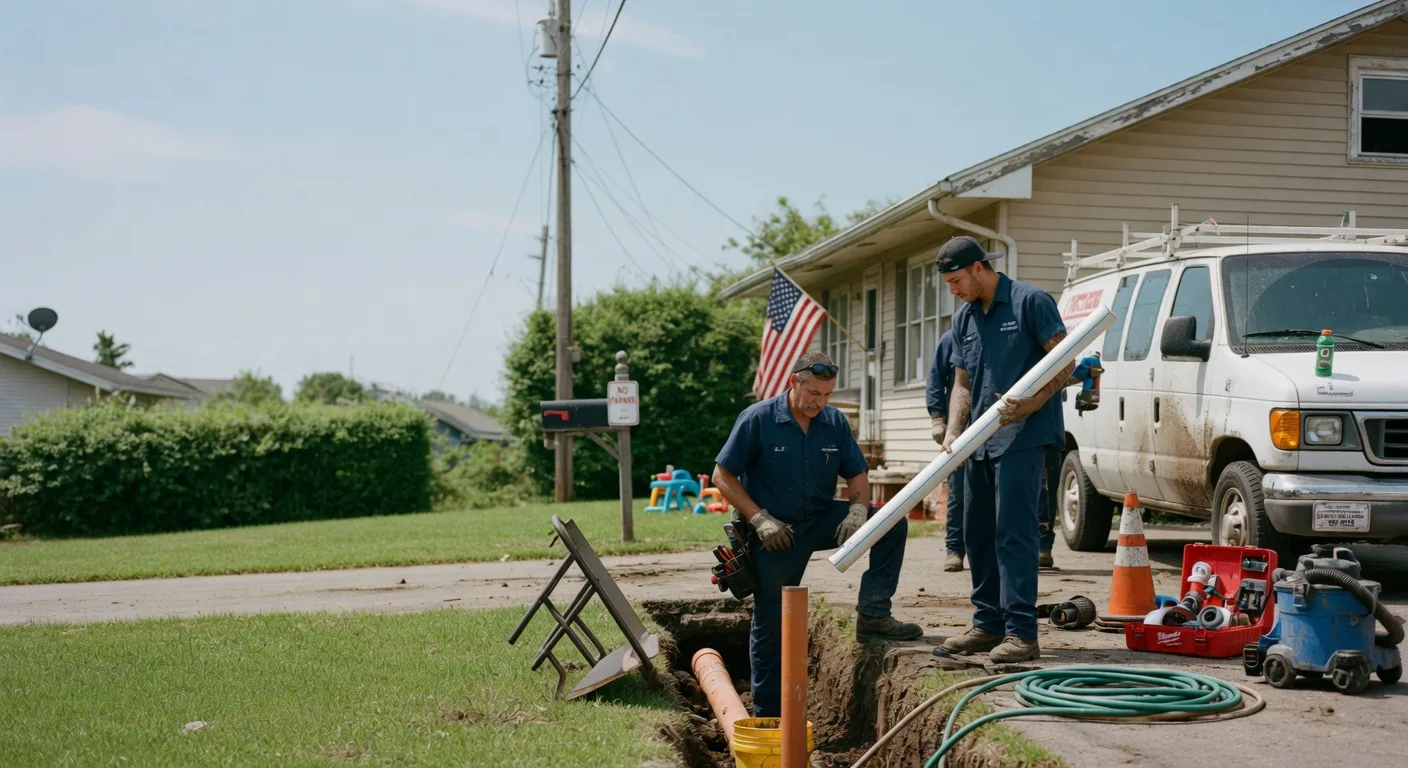
How often does a main sewer line actually need cleaning?
There is no set interval that fits every house. A main sewer line in good shape, with no symptoms, does not need cleaning on a calendar. A line with a known problem often does.
The usual reasons a main line needs repeat attention are root intrusion at a clay or loose joint, grease build-up on the pipe wall, or a bellied section that holds water and collects solids. Those problems do not go away after one cleaning. Roots regrow. A belly keeps holding water. A line like that may need cleaning on a schedule that suits what is found in it.
The way to set that schedule is a camera inspection. It shows the cause, the condition of the pipe and where the trouble sits, so the interval is based on what is in the line and not a guess.
Watch for the signs: slow drains in several fixtures, gurgling, a sewage smell, or the lowest drain in the house backing up. One slow sink is usually a branch line job. Several fixtures at once points to the main.
A cable machine is often enough for roots and soft blockage. Heavy grease or scale needs hydro jetting. A failed sewer lateral needs repair, not cleaning, and cost then depends on access, the materials, how much is opened up and any permit required. If sewage is backing up, stop running water and call. Expert Plumbers Co is a referral service. We refer you to a local plumber for Drain Cleaning or Emergency Drain Cleaning in Bristol, VA: (380) 262-9173.
What you notice between cleanings is more useful than the date on the calendar. Keep a simple note of when drains slow, when gurgling starts and how long each cleaning lasted. If the gap between problems keeps shrinking, the cause is getting worse and a camera inspection should come before the next cleaning. Older homes with clay or cast iron mains often show roots or scale returning within a year or two, while newer plastic mains usually stay clear much longer unless a joint has shifted or something was flushed that should not have been. A common mistake is paying for repeated cleanings without ever seeing the inside of the pipe. After a thorough cleaning and inspection, ask the plumber what the line looked like, how much was removed and when it makes sense to look again, so you leave with a plan.
Does hard water cause drain problems, or only water heater problems?
The bathroom sink used to run fine. Now it drains a little slower each month. That slow creep is the sign of scale, not a clog.
Hard water does more than coat a water heater. Minerals from the supply side leave a chalky layer inside a trap. In a bathroom line they bind with soap residue into a hard, grey film. The bore narrows a fraction at a time, so you notice a gradual slowdown rather than a sudden blockage.
Old cast iron is a different problem. Inside drain pipe that has been in the ground or a wall for decades, rust forms lumpy mounds called tubercles. These are not hard-water minerals. They are the pipe corroding from within, and they snag grease and paper.
The two tools do different work. A cable punches a hole through the build-up. Water drains again, but the scale stays on the wall and the line narrows again. Hydro jetting strips the wall back to the pipe surface.
Jetting old iron hard without looking first is a gamble, because thin, flaking pipe can fail under pressure. That is why a camera inspection comes first on old iron. It shows wall condition and cracks before anyone sets the pressure.
Safe homeowner check: find out whether one fixture is slow or every drain in the house is, then clean the visible stopper and trap.
Stop running water and call now if several drains slow together, or water backs up at a floor drain. One slow bathroom sink is usually a cable or trap job. A whole-house slowdown in old iron often needs a camera first and possibly jetting.
Expert Plumbers Co is a referral service. We connect you with an independent local plumber in Bristol, VA. Call (380) 262-9173.
A water softener changes the picture a little, and it is worth telling the plumber if you have one. Softened water leaves less mineral scale, but it can feel slippery and does not stop soap and hair from building up on the pipe wall. If your water is hard and you have no softener, the mineral film inside traps and short branch lines is the main cause of the slow creep. A simple habit helps: use a hair catcher in the tub and basin, and rinse the sink with hot tap water after use so soap does not cool and settle on the wall. Do not rely on vinegar or store-bought descalers to clear a drain, as they only treat the surface. In newer homes with plastic pipe, scale is mostly a trap and fixture issue. In older homes with iron or galvanized pipe, scale and corrosion together can narrow a line enough that replacing a section is more sensible than repeated cleaning.
My child flushed a toy, or something solid went down the toilet. What should I do, and what should I not do?
Stop first. Do not flush again, even if the water looks like it is going down. Each flush pushes the object further along, and it can lodge in the toilet's trap or in the drain behind it. Tell everyone in the house not to use that toilet.
If the toilet still drains but the bowl is high, leave it. If it is rising toward the rim, lift the tank lid and push the flapper down, or turn the shutoff valve behind the toilet clockwise to stop more water entering.
What is safe to try: if you can see the object near the bowl opening and it is not breakable, put on gloves and pick it up. Use a wet vac or a closet auger only if you are comfortable with it, because an auger can also shove a hard toy deeper. Be gentle with a plunger. A plunger can free a soft item, such as paper or cloth, but it often wedges a solid piece tighter.
What not to do: do not use chemical drain cleaners, which do nothing to a solid object and make the water dangerous to handle. Do not keep plunging hard, and do not push a coat hanger down the drain, which can scratch the porcelain or drive the object into the pipe wall.
If the object has already gone and the toilet seems normal, watch for slow drains, gurgling or other fixtures backing up over the next few days. A small toy can catch in a bend and collect paper behind it. If the toilet becomes slow, or the same one keeps clogging, the object is probably still in the line.
In that case the plumber may pull the toilet off its seat to retrieve it from underneath, which is often cleaner than cabling into a pipe. If the item is in the drain behind the toilet, a camera can find it and the plumber can retrieve it or push it clear. Cost depends on where it lodged, whether the toilet must be removed, and how much access is needed.
Expert Plumbers Co can connect you with an independent plumber in Bristol, VA for this: call (380) 262-9173.
My sink gurgles after it drains and someone mentioned an air admittance valve. What is that, and can it fail?
"My sink gurgles after it drains" is one of the most common things people notice before a drain problem gets worse. Every fixture needs a vent so water leaving the trap does not pull a vacuum. When air cannot get in, it gets dragged through the trap water instead, and that is the gurgle.
An air admittance valve, or AAV, is a small one-way valve fitted on a vent pipe, often under a sink or in an attic. It opens to let air in as water drains, then drops shut so sewer gas stays in the pipe. Many local codes allow them and some do not, so rules vary by area.
Yes, they can fail. The rubber seal wears, dust or debris stops the flap seating, or the valve sticks. A valve that will not open brings back the gurgling and slow draining. One that will not close lets a sewer smell into the cabinet or room.
A blocked vent stack on the roof, a partial clog in the drain, or a bellied line holding water can also cause gurgling. One gurgling fixture usually points to its own trap, branch line or vent. If the tub, toilet and floor drain all gurgle together, or the toilet bubbles when the washer empties, suspect the main line or the main vent.
Safe homeowner check: Run just the gurgling sink and listen, then run another fixture and see if it does the same. Do not pry at vent parts inside walls, and do not pour drain chemicals into a line that is already gurgling.
Stop running water and call now if sewage smell is strong, water comes up in a tub, shower or floor drain when you use another fixture, a toilet bubbles or rises, or any fixture stops draining.
A cable machine is usually enough for a clog in a single branch line, like the pipe behind one sink. If the gurgle returns, or several fixtures are affected, the plumber may want a camera inspection to look for root intrusion at a clay joint, a bellied line, or a failing section. A blocked roof vent is cleared from the roof, not with a drain cable.
Expert Plumbers Co is a referral service. We connect you with an independent local plumber in Bristol, VA. Call (380) 262-9173.
Ask the plumber whether an AAV is permitted where you live, or whether a conventional vent is needed instead. Cost depends on access to the pipe, the parts or materials needed, how much wall or ceiling has to be opened, and any permit or code requirement.
Our drains only back up in the morning when everyone is showering. Why only then?
Everything is fine all day, then at seven in the morning the shower pan fills up and the toilet gurgles. This is the classic sign of a partial blockage in the main drain.
A line with a partial clog still carries a normal trickle. One person washing their hands never notices. But when two showers, a washer and a toilet all run at once, more water arrives than the narrowed pipe can pass, and the extra has nowhere to go but up the lowest opening in the house. Once the rush ends, the pipe catches up and the problem seems to vanish.
The usual causes are a root mat growing through a clay joint, a bellied section of pipe that holds a pool of water and debris, grease build-up on the pipe wall, or scale narrowing an old cast iron line.
The key question is how many fixtures are affected. One slow fixture, such as a single shower, usually points to a clog in that fixture's own trap or branch line. When the tub, floor drain and toilets all struggle at the same time, the problem sits in the shared main, and it will keep returning at peak load until it is cleared properly.
Safe homeowner check: stagger your mornings for a day. Run one shower, then wait, and watch whether the lowest drain in the house, often a basement floor drain or a ground-floor tub, stays calm. Note which fixtures react first and write down the times. That list is useful to the plumber.
Stop running water and call now if sewage is coming up in a tub or floor drain, if a drain is overflowing onto the floor, or if you smell sewage inside the house. Do not keep using showers and the washer while the line is backed up.
A cable machine is often enough for a soft blockage such as a small grease or paper clog. If roots, a belly or heavy build-up is suspected, the job usually needs a camera inspection to see the pipe, and hydro jetting to clean the pipe wall rather than just poke a hole through the clog.
Expert Plumbers Co is a referral service. We connect you with an independent local plumber in Bristol, VA. Call (380) 262-9173.
When you speak to the plumber, mention that the backups only happen at peak use. Ask whether a camera inspection is included before any jetting, and ask what they found on the pipe, not just that it was cleared. Scope and cost depend on access to the line, whether a cleanout exists, how much has to be opened up if a section is damaged, and any permit or code requirement for repairs.